close
Choose Your Site
Global
Social Media


 |


| Quantity: | |
|---|---|

| Introduce the basic functions of the product |
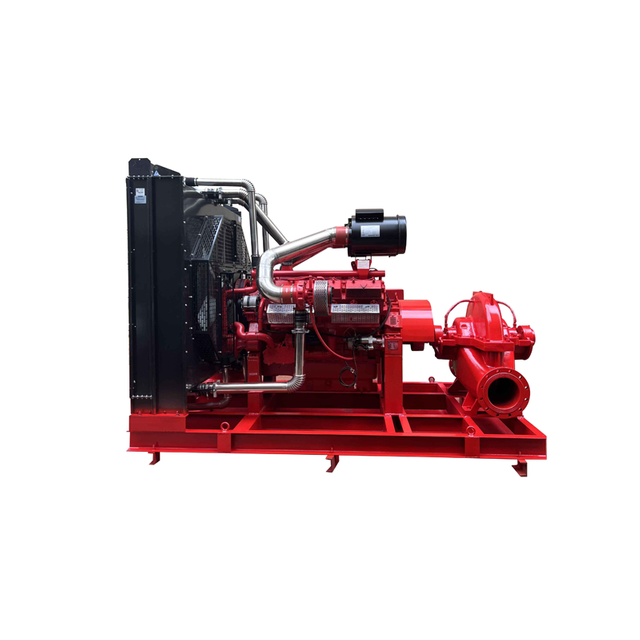
1. High-flow-rate fluid transport: The dual-suction impeller design enables efficient and stable high-flow-rate media transportation, adapting to various water supply needs under different operating conditions. 2. Multi-scenario media adaptation: It can transport clean water and liquids with similar physical and chemical properties, meeting the needs of water supply, industrial circulation, irrigation, fire fighting and other scenarios. 3. Convenient inspection and maintenance: The horizontal split-case pump casing structure allows for the inspection and maintenance of internal components without disassembling the inlet and outlet pipelines, reducing operation and maintenance costs. 4. Stable and low-power operation: The impeller's axial force is self-balancing, resulting in low operating vibration and noise, while also possessing high efficiency and energy-saving characteristics, thus extending the equipment's service life. |
| Usage Environment |
1. Transport medium: Water and liquids with similar physical and chemical properties, with a medium temperature ≤105℃. 2. Operating pressure: Permissible working pressure ≤ 2.5MPa. 3. Application Scenarios: Water supply for waterworks, circulating water for power plants, industrial water transmission, fire fighting, and agricultural irrigation. |
| Product Advantages |
1. High efficiency and energy saving: CFD-optimized flow channels result in 2%-5% higher efficiency and lower energy consumption compared to similar products. 2. Stable operation: Axial force self-balancing, rotor dynamic balance G1.0 level, low vibration and low noise. 3. Easy maintenance: The horizontal split design eliminates the need to disassemble the pipeline for maintenance, saving time and effort. 4. High adaptability: With a wide range of models, it can meet the flow and head requirements of various working conditions, and is resistant to cavitation and has a high pump body pressure resistance. |
| Technical parameters |
| type | TPOW split-case volute single-stage double-suction centrifugal pump |
| Material | Ductile iron (2.0MPa), cast steel (2.5MPa) / cast iron |
| Driver type | Three-phase asynchronous motor drive |
| Installation type | Horizontal installation |
| Maximum caliber | DN800 mm (Φ800) |
| Maximum flow | 11600 m³/h |
| Maximum head | 200 m |
| Maximum power | 2500 kW |
| Protection level | motor IP54/IP55 |
| Insulation class | F-level |
| Standard voltage | 380V, 660V, 6kV, 10kV |
| Product Uses |
1. Municipal water supply: Water intake, water transmission, and pressurization of the water supply network 2. Industrial cycle: Cooling circulating water transportation in power plants, chemical industry, metallurgical industry and other industries 3. Building Heating, Ventilation and Air Conditioning: Central air conditioning chilled and hot water circulation system 4. Irrigation: Large-scale irrigation and drainage of farmland and gardens 5. Fire emergency response: Fire water supply systems for various buildings and industrial and mining enterprises |
| Product Operation Guide |
1. Before starting Check the oil level, seals, and valve status; fill the pump chamber to purge air; and briefly start the motor to confirm the direction of rotation. 2. Running Slowly open the outlet valve, monitor the pressure, flow rate, vibration and temperature rise, and strictly prohibit dry running. 3. During shutdown First close the outlet valve, then disconnect the power supply. If the pump is to be shut down for an extended period, the liquid inside the pump must be drained. |
| Frequently Asked Questions |
1. Excessive pump body vibration: Impeller imbalance, bearing wear, loose foundation, or misalignment of coupling. 2. Insufficient flow rate and head: The problem could be caused by a blocked inlet, valve not being fully open, impeller cavitation, or low speed. 3. Seal leakage: Packing wear, mechanical seal failure, or shaft sleeve damage. 4. Motor overload: The medium has an excessively high specific gravity, the head is too high, or there are foreign objects blocking the pump cavity. 5. Abnormal noise from the pump body: The bearings are lacking oil, the impeller is rubbing against the pump casing, or there is cavitation. |