close
Choose Your Site
Global
Social Media


 |


| Quantity: | |
|---|---|
Basic information of the product
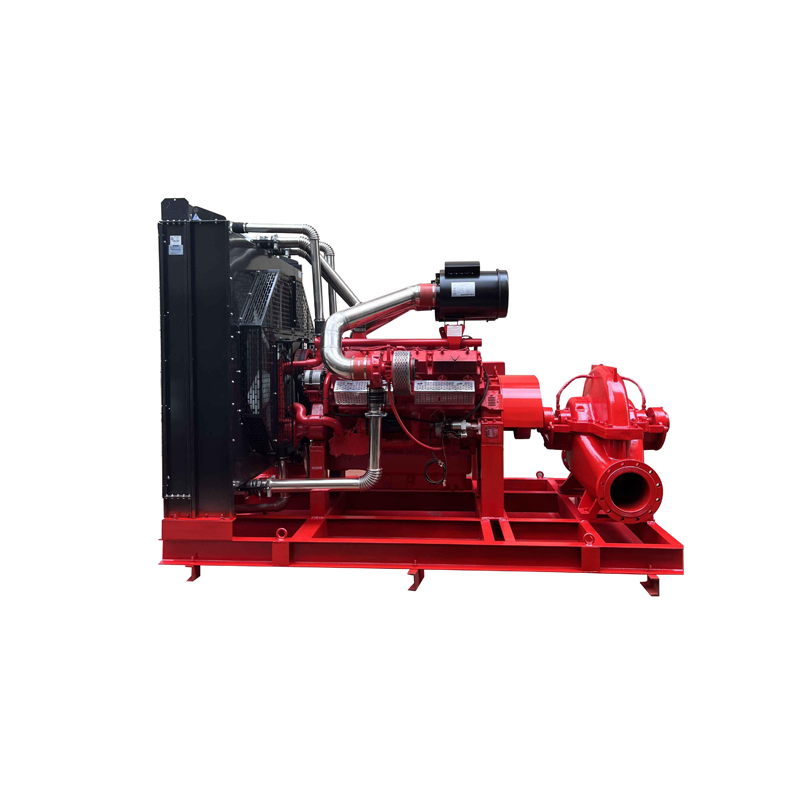
The XBC diesel engine fire pump unit consists of a diesel engine, a chassis, a cooling water tank and fan, a high-elastic coupling, a water pump, a diesel tank, and a control panel.
Usage Environment
Different pumps and valves are selected according to different situations, and are widely used in various fire water supply occasions such as agricultural irrigation, disaster relief, smelting, hangars, petrochemical oil depots, power plants, liquefied gas stations, textiles, etc. XBC fire pumps are driven by diesel engines. When the power grid cannot meet the demand, the diesel engine can be used to drive the water pump to ensure that the unit can reach the operating state.
Product Advantages
Diesel Engines Tailored for Fire Water Pump Applications
High reliability, strong emergency response capability, excellent automation, good pressure and flow adaptability, flexible and convenient installation
Product Features
Powerful and efficient, excellent emergency performance, intelligent automation, high adaptability, sophisticated and durable structure
Technical Parameters
| Pump Type | Diesel Fire Pump |
| Material | Pump body materials, impeller materials, diesel engine parts materials, sealing materials |
| Drive type | Diesel engine drive |
| Maximum flow | Up to 1000L/s |
| Maximum lift | 110m |
| Installation Type | Horizontal |
| Maximum caliber | 500mm. |
| Maximum Power | 200KW |
| Protection level | IP54/IP55 |
| Insulation class | F-Class/H-Class |
| Standard voltage | 380V or 400V |
Product Usage
High-rise buildings: It can meet the fire-fighting water needs of high-rise office buildings, residential buildings, etc. With its high lift characteristics, it can transport water to a height of more than 100 meters, ensuring that when a fire occurs, high-rise areas can also obtain sufficient fire-fighting water, effectively extinguish the fire, and protect the lives and property of personnel.
In various industrial sites, such as chemical plants, steel mills, and refineries, the risk of fire is high and complex. This fire pump can cope with different types of fires. Its strong flow rate and stable pressure output can quickly deliver a large amount of fire water to extinguish fires caused by flammable liquids, electrical equipment, etc., to ensure the safety of production facilities and personnel.
Commercial areas with dense population and complex building structures, such as shopping malls, hotels, and shopping centers, require large and continuous firefighting water once a fire occurs. XBC diesel fire pumps can start quickly to provide sufficient water volume and pressure for the firefighting pipe network in the entire commercial area, covering a large area of fire extinguishing and preventing the fire from spreading.
Warehouses usually store a large amount of goods, including flammable items. The large flow of fire pumps can quickly extinguish fires in large warehouses, prevent the fire from spreading and causing major losses, ensure the safety of goods and warehouse facilities, and maintain the stability of the logistics supply chain.
Municipal fire protection engineering: As an important part of the city's fire protection system, when the city's water supply network pressure is insufficient or fails, the XBC diesel engine fire pump can be used as an emergency water supply equipment to ensure the fire safety of key areas in the city, such as public squares, transportation hubs, etc., and enhance the city's overall fire emergency response capabilities.
Product Operation Guide
Preparation before starting: Check whether the connections of the pump body parts are firm, whether the lubricating oil level is normal, whether the fuel tank has enough oil, whether the diesel engine cooling system is normal and leak-free, whether the valves are in the correct open and closed state (the suction valve is fully open, and the discharge valve is slightly open), the electrical circuit connection is correct, and manually turn the wheel several times to ensure that there is no jamming. Start the diesel engine: Turn on the diesel engine fuel switch, put the governor control handle in the start position, press the start button, and release it immediately after starting. Observe the running status of the diesel engine. After it runs stably, adjust the governor control handle to the appropriate speed so that the pump outlet pressure reaches the required working condition. Monitoring during operation: Pay close attention to the pump's inlet and outlet pressure, flow, diesel engine oil pressure, water temperature, speed and other parameters to ensure that they are stable within the normal range, listen to the equipment running sound, and check whether there is abnormal vibration, noise or leakage. If any abnormality is found, stop the machine immediately for inspection. Shutdown operation: first slowly close the discharge valve of the pump, then gradually adjust the diesel engine governor control handle to a low speed, press the stop button to stop the diesel engine, turn off the fuel switch, cut off the power supply, close the suction valve of the pump, drain the remaining water in the pump body and pipeline (if the ambient temperature is low, antifreeze measures must be taken), and keep records of equipment cleaning and maintenance.
Frequently asked questions
1. Water leakage from mechanical seal
Difficulty in starting. Check the starting circuit, fuel supply system and cylinder compression efficiency. If necessary, adjust the fuel supply sequence or repair the starting system.
2. Reversal
Unstable operation Check and tighten loose parts, and replace worn mechanical parts if necessary.
3. The motor is hot
Insufficient or no water output may be caused by a clogged water inlet pipe, a pump shaft seal problem, or a clogged filter. Solutions include cleaning the water inlet pipe, replacing the seal, and cleaning the filter.
4. The water pump is noisy
Overheating may be caused by a cooling system failure or a deterioration in water pump performance. Solutions include checking the cooling system performance and replacing or repairing the water pump.