close
Choose Your Site
Global
Social Media


 |


| Quantity: | |
|---|---|
Basic functions of the product
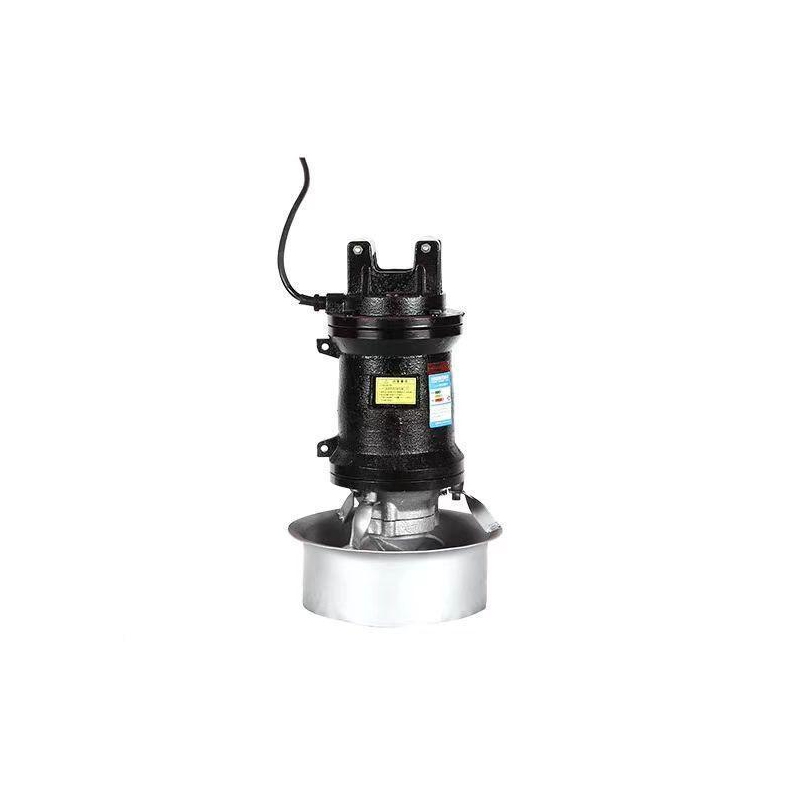
The impeller is driven by the motor to rotate, generating a strong water flow, so that the impeller drives the surrounding water to generate strong circulation and tangential flow, thereby achieving the purpose of mixing, stirring and pushing flow. Its working principle depends on the coordinated work of the motor and the impeller. The motor drives the impeller to rotate at high speed, generating a strong water flow. The design of the impeller enables the water flow to form a strong circulation and tangential flow, effectively mixing and stirring the particles in the water.
Basic information of the product
Submersible mixers are generally divided into two types: hybrid submersible mixers and low-speed submersible propulsion mixers. The hybrid mixing series uses multi-pole motors and a direct-connected structure with low energy consumption and high efficiency. The impeller is precision-cast or stamped, with high precision, high thrust, beautiful and smooth appearance, and compact structure. The low-speed propulsion series uses a cycloid pinwheel reducer or a gear reducer with low power, low speed, large impeller diameter, and a wide service area. These two types of submersible mixers have their own characteristics and are suitable for different application scenarios.
Usage Environment
1. Water quality conditions Medium temperature should be ≤40℃, the pH value of the medium should be between 5 and 9, liquid density does not exceed 1150kg/m³
2. The diving depth of the installation environment is generally not more than 20 meters, the submersible mixer must be fully submerged in water to work, away from obstacles, to ensure stable installation
3. It is forbidden to use in flammable, explosive and highly corrosive environments, the cable needs to take appropriate protective measures to prevent damage.
Product Advantages
High-Efficiency Submersible Mixer for Sludge and Wastewater Treatment
Efficient and powerful mixing capacity, flexible and diverse application range, reliable and stable performance, energy saving and environmental protection, easy maintenance
Product Features
Compact structure, small size, light weight, anti-entanglement and self-cleaning function、High efficiency mixing capacity, low energy consumption and high efficiency
Technical Parameters
| Pump Type | Submersible mixer |
| Material | Cast iron stainless steel (304/316L) |
| Drive type | electric |
| Maximum lift | Stirring diameter 620 |
| Installation Type | Wet |
| Maximum Power | 10KW |
| Protection level | IP68 |
| Insulation class | F-Class |
| Standard voltage | 380V, 220V, 400V, 415V, 440V, 660V, 1140V |
Product Usage
Water treatment plant: Submersible mixers are widely used in mixing tanks and reaction tanks in water treatment plants. Through stirring, chemical substances or microorganisms in the water are fully mixed and reacted, improving water treatment efficiency and quality. In addition, submersible mixers can also prevent sludge deposition and scaling, ensuring the normal operation of water treatment equipment.
Environmental protection: In the treatment and restoration of natural water bodies such as lakes and rivers, submersible mixers increase the oxygen content in the water, promote the growth and activity of aerobic microorganisms, accelerate the decomposition and transformation of organic pollutants, improve water quality, and restore ecological balance
Agricultural breeding: In fish ponds and aquaculture farms, submersible mixers are used to circulate and stir water, increase oxygen, improve water quality, and promote fish growth. In farm irrigation systems, submersible mixers prevent suspended matter and silt in the water from clogging the system and ensure the normal flow of water.
Sewage treatment: Submersible mixers are used in sludge tanks and aeration tanks in sewage treatment plants to prevent sludge sedimentation and promote the mixing of sewage with return liquid and recirculating water. They provide the necessary circulation flow rate to keep the mixed liquid in the tank suspended, ensure that microorganisms are fully in contact with the substrate, and promote biochemical reactions.
Product Operation Guide
Preliminary preparation:
1. Equipment inspection: Before using the submersible mixer, it is necessary to conduct a comprehensive inspection of the equipment to ensure that the power cord, plug, motor, and agitator and other components are not damaged or abnormal. Check the transmission mechanism, working device, brake, etc. to ensure reliable fastening.
2. Choose the right model: According to the area, depth, temperature and required mixing effect of the natural water body, choose the right submersible mixer model. Make sure that the power of the selected mixer can reach the expected mixing depth. Install the bracket or suspension device: If you choose a submersible mixer with an underwater bracket, you need to set up the bracket at the bottom of the water; if you choose a submersible mixer directly suspended under the water surface, you need to prepare the suspension device.
Installation and commissioning:
Install the agitator: Install the selected agitator on the submersible mixer, and ensure that the agitator is kept at a sufficient distance from the bottom of the container to avoid friction and damage. Connect the power supply: Plug the submersible mixer plug into the power socket, turn on the power switch, and check whether the motor is operating normally. Adjust the speed and time: Adjust the speed and time of the submersible mixer as needed. Generally, a stirring speed of about 60 rpm is best. The stirring time needs to be determined according to the water conditions and the power of the stirrer to ensure that the stirring effect is achieved without causing excess oxygen in the water.
Frequently asked questions
The device cannot start
Check whether the overload protection is reset, whether the impeller rotates flexibly, whether the power switch is turned on, whether the power supply voltage is normal, whether the motor cable is broken, whether the starting device has control voltage, whether the fuse is intact, and whether there is voltage on each phase of the wire.
Poor stirring effect
Check whether the impeller is worn or blocked, clean the debris on the impeller or replace the worn impeller, check whether the motor speed is normal, adjust the motor speed or replace the appropriate motor, adjust the position and angle of the mixer to ensure that it can fully stir the water.
Excessive noise
Check whether the bearing is worn or poorly lubricated, replace the bearing or add lubricant in time, check whether the mechanical seal is damaged, replace the mechanical seal in time, ensure that the mixer is firmly installed to avoid resonance.
Water Leakage
Check whether the mechanical seal is aging or damaged, and replace it with a new one in time.OCheck whether the seals such as the ring are intact. If damaged, replace them in time.
Motor overheating
Check whether the motor load is too large, reduce the load appropriately or replace a motor with a higher power; check whether the cooling system is working properly to ensure that the motor is adequately cooled; regularly clean the dust and debris around the motor to maintain good heat dissipation conditions.