close
Choose Your Site
Global
Social Media


 |


| Quantity: | |
|---|---|
| Introduce the basic functions of the product |
1. Emergency self-priming drainage: No priming required; rapid self-priming within 30-60 seconds; capable of pumping turbid water containing mud, sand, and weeds.
2. Mobile and flexible operation: Trailer-mounted design; can be towed to flooded streets, foundation pits, tunnels, and other emergency response sites, without site limitations.
3. Independent and continuous operation: Self-powered by diesel fuel; no external power supply required; supports 24-hour uninterrupted drainage.
4. Intelligent and convenient control: One-button start/stop; some models support remote monitoring; flow rate and head can be adjusted as needed.
| Usage Environment |
1. Medium: Rainwater, sewage, and turbid stagnant water containing mud/weeds; avoid pumping strong acids, alkalis, or other highly corrosive liquids. 2. Temperature: Ambient temperature 0–38℃, medium temperature 0–40℃. 3. Site: Flat, hardened ground; suitable for muddy construction sites, street flooding areas, and other temporary emergency response sites. 4. Altitude: ≤1000m; use at lower altitudes requires reduced rating. 5. Climate: Can withstand heavy rain and dusty weather; avoid prolonged immersion. |
| Product Advantages |
1. No pre-priming required: Equipped with a self-priming vacuum system, it can self-prime water in 30-60 seconds, eliminating the need for pre-priming and allowing immediate operation upon arrival, perfectly suited for flood control and disaster relief emergency needs. 2. Highly mobile and flexible: Adaptable to all scenarios with its trailer/vehicle-mounted design, it can be towed by pickup trucks or vans, easily accessing narrow emergency areas such as street flooding points, underground garages, and foundation pits, without being limited by site constraints. 3. Diesel-powered: Independent operation without external mains power. Driven by its own diesel engine, it supports 24-hour uninterrupted drainage, ensuring stable operation even in power-deficient disaster areas and construction sites. 4. High flow rate and anti-clogging: High drainage efficiency. Utilizing an anti-clogging impeller design, it can pump turbid water containing mud, sand, and weeds without clogging; its high flow rate (300-6000 m³/h) and high head quickly lower water levels. 5. Simple operation: One-person operation is possible with one-button start/stop and intelligent control cabinet. Some models support remote monitoring. No professional technicians are required; deployment and operation can be completed by two people, saving labor costs. 6. Durable and reliable, adaptable to extreme working conditions: Key components are made of cast iron/stainless steel, rainproof and dustproof, and can withstand outdoor heavy rain, high temperature and dusty environments. It features low vibration and low failure rate, meeting the needs of long-term emergency rescue. |
| Technical parameters |
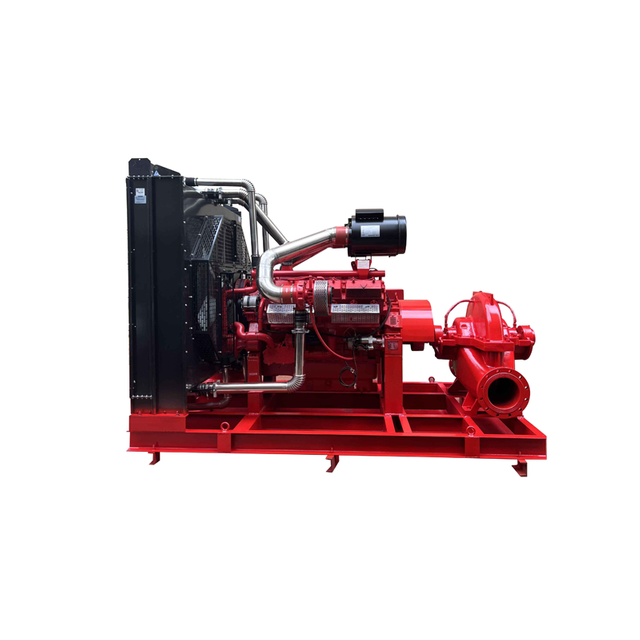
| type | High-flow municipal drainage pumps |
| Material | cast iron |
| Driver type | diesel engine |
| Installation type | Horizontal |
| Maximum flow | 1000 cubic meters |
| Maximum head | 100 meters |
| Maximum power | 500KW |
| Protection level | IP55 |
| Insulation class | F |
| Standard voltage | 220V 380V 400V 480V 50Hz |
Product Uses |
1. Urban Flood Control: Pumping out floodwater from streets, underpasses, underground parking garages, and subway stations to quickly restore traffic and public order. 2. Municipal Water Conservancy Drainage: Drainage from rivers, lakes, and reservoirs during the flood season; emergency pumping out of municipal pipe networks; temporary alternative drainage during pump station maintenance periods. 3. Construction Drainage: Pumping out rainwater from construction site pits, tunnel shafts, and basements to ensure construction progress; wastewater discharge from mine tunnels and sand washing plants. 4. Industrial Park/Community Emergency Drainage: Rainwater backflow in industrial parks and residential areas; clearing floodwater from key locations such as schools and hospitals. 5. Post-Disaster Emergency Relief: Drainage of farmland and villages after floods; temporary drought relief water supply; and emergency water supply for fire fighting. |
| Product Operation Guide |
Preparations before starting the pump truck: I. Upon receiving the goods, inspect their integrity for any major damage. II. Connect the water inlet pipe, ensuring the clamps are tight. Pay special attention to the pipe joints to ensure the water inlet pipe is sealed. III. For first-time use of the diesel engine, add antifreeze, engine oil, and diesel fuel. Add engine oil or grease to the pump bearings as instructed. IV. Before connecting the water outlet pipe, fill the pump chamber with clean water and check the water outlet pipe for a secure and sealed connection. V. Correctly connect the positive and negative terminals of the battery and check for a secure connection. Do not allow loose connections! Starting the Diesel Engine: I. For first-time use of the diesel engine, the air in the fuel inlet pipe needs to be purged. 1. Loosen the bleed screw on the fuel inlet pipe and repeatedly press the hand pump. 2. Once diesel fuel comes out of the bleed screw without any air bubbles, tighten the bleed screw. II. Starting the Diesel Engine: 1. Insert the key and turn it clockwise until the voltmeter displays the voltage. 2. Press the black start button to start the diesel engine. 3. Adjust the throttle lever to the appropriate speed and hold it. The water pump is now operational. III. Stopping the Diesel Engine 1. Release the throttle lever until the engine is running at high speed. 2. Turn off the key (for electronically fuel-injected diesel engines, simply turning off the key will stop the engine; step 3 is unnecessary). 3. Push the engine stop lever to stop the diesel engine. |
| Frequently Asked Questions |
1. The most common causes of failure to self-prime or slow water output are air leaks at the suction pipe joint or blockages in the inlet filter; secondly, insufficient water in the pump body's water storage chamber, self-priming height exceeding the rated value, or impeller obstruction by weeds or mud.
2. Diesel engine starting failures are often due to insufficient fuel/fuel line blockage, a dead battery, damaged spark plugs, or lack of antifreeze in low-temperature environments or excessive engine oil viscosity.
3. Excessive vibration and abnormal noise during operation are usually caused by improperly leveled engine support feet, misalignment between the pump shaft and diesel engine shaft; it could also be due to impeller wear imbalance or loose pipeline fixing causing resonance.
4. Insufficient flow and head are caused by factors including the throttle not being opened to maximum, excessive resistance in the outlet pipeline; impeller scaling and blockage, excessive air intake during self-priming, or actual operating conditions exceeding the pump's rated parameters.
5. Pipeline/pump body leaks include aging gaskets at joints, damaged pipelines; worn mechanical seals causing shaft end leakage, or loose pump body flange bolts.