close
Choose Your Site
Global
Social Media


 |


| Quantity: | |
|---|---|
Introduce the basic functions of the product
1. Liquid delivery functionThe most basic function of the D-type multistage pump is to transport liquids. It can transport water or water-like liquids from one place to another. For example, in the city's water supply system, it can transport water from water sources (such as reservoirs, rivers, etc.) to water plants for treatment, and then transport the treated water to various areas of the city. This transportation function can span a long distance because it has the characteristics of high head. Whether in flat urban areas or in places with certain terrain undulations, it can effectively complete the task of liquid transportation.
2. The function of increasing liquid pressure Due to its multi-stage impeller structural design, the D-type multistage pump can increase the pressure of the liquid. Each stage of the impeller will add a certain amount of energy to the liquid, so that the pressure of the liquid gradually increases. In the industrial production process, some chemical reactions or equipment operations require liquids to be carried out under a certain pressure. For example, in the high-pressure reactor feeding process in chemical production, the D-type multistage pump can raise the raw material liquid to the required pressure and then transport it to the reactor to meet the requirements of the production process.
3. The function of meeting different flow requirements The D-type multistage pump has a wide flow range and can flexibly adjust the flow according to the actual application scenario. By selecting different models, different impeller sizes and adjusting the running speed of the pump, different flow rates of liquid can be output. In the temporary water supply system in the construction field, when a local area of the building needs to be quickly filled with water (such as refilling the water tank after cleaning), the D-type multistage pump can be adjusted to work at a larger flow rate; in the daily stable water supply stage, the flow rate can be adjusted to a lower level to meet normal use.
4. Stable output function The pump can stably output liquid under the designed working conditions. Its internal bearings, sealing devices and other components ensure the stable rotation of the pump shaft, and the impeller can continuously and evenly work on the liquid. In the fire water supply system, the D-type multistage pump needs to be able to start immediately when a fire occurs and stably provide fire protection facilities with water of sufficient pressure and flow. This stable output function is very important for responding to emergencies such as ensuring fire safety.
Usage Environment
1. Temperature environment D-type multistage pumps are generally suitable for conveying liquids with temperatures between 0 and 80°C. Within this temperature range, the material properties of the pump body can remain stable, and the seals and other parts can also work normally. For example, in ordinary urban water supply systems, the water temperature is usually in this suitable range, and the D-type multistage pump can operate well. If the liquid temperature is too high, it may cause the pump body material to expand, affect the gap between the impeller and the pump casing, reduce the efficiency of the pump, and even damage the sealing device, causing leakage; if the temperature is too low, the liquid may freeze, causing damage to the impeller, pump casing and other components. Geographical environment and installation location
2. Indoor environment: It can be installed in indoor industrial plants, pumping stations, basements and other locations. Indoor installation is convenient for maintenance and management, and can avoid the impact of some harsh natural environmental factors (such as wind, sand, rain and snow, etc.) on the pump. For example, in the workshop of a chemical plant, the D-type multistage pump can be installed in a pump room close to the production equipment to convey cooling water or process water. Outdoor environment: It can also adapt to a certain outdoor environment. However, when installing outdoors, measures such as rain protection, sun protection, and antifreeze need to be considered. For example, in some pumping stations for farmland irrigation, the pump may be installed in an open-air environment beside the field. To prevent rainwater from entering the motor and causing a short circuit, a rain cover needs to be installed; to avoid direct sunlight causing the pump body to overheat, a sunshade can be set up; in cold areas, insulation or drainage measures are also required to prevent the pump body from freezing and cracking.
3. Terrain conditions: The D-type multistage pump has good adaptability to terrain. It can be installed in flat areas or in places with a certain slope or height difference. In water lifting and irrigation projects in mountainous areas, even if there is a large altitude difference, it can still effectively lift water from low to high through reasonable pipeline connection and selection.
4. Medium environment cleanliness: Suitable for conveying relatively clean liquids. If the liquid contains a large amount of solid particles, fibers and other impurities, it may clog the impeller and wear the pump body and sealing parts. For example, when conveying river water containing sediment for irrigation, the river water needs to be precipitated or filtered first, otherwise it will affect the service life and performance of the pump.
5. Chemical properties: Mainly used to convey liquids with physical and chemical properties similar to water. For some highly corrosive liquids, such as strong acids and alkalis, special treatment of the pump body material is required, such as the use of corrosion-resistant alloy materials or anti-corrosion coating treatment. In the chemical industry, when conveying slightly corrosive process liquids, D-type multistage pumps can also work normally through appropriate material selection.
Product Advantages
Stainless Steel D-Type Multistage Pump | Corrosion-Resistant Design
High efficiency in hydraulic performance: The D-type multistage pump adopts an advanced hydraulic model, which can efficiently convert the energy input by the motor into the kinetic energy and pressure energy of the liquid. It has high operating efficiency, can reduce energy consumption and reduce operating costs. Wide performance range: The flow range is generally 6.3-850m³/h, and the head range is 13-900m, which can meet the needs of various working conditions such as mine drainage, urban water supply and drainage, high-rise building pressurized water supply, and cooling water circulation of air-conditioning units. Good cavitation performance: Reasonable impeller design and pump body structure enable the pump to have good cavitation performance during operation, which can effectively avoid cavitation caused by liquid vaporization, extend the service life of the pump, and ensure stable operation.
Stable and reliable operation with low vibration: The rotor of the pump has been precisely processed and balanced, and the vibration generated during operation is small, which reduces the wear on the pump body and connecting pipes, and also reduces the operating noise, providing users with a quieter working environment. Low noise: Through optimized design, such as the use of low-noise impellers, reasonable flow channel shapes, etc., as well as good assembly technology, D The noise level of the multistage pump is low during operation, generally lower than the noise limit specified by the industry standard, which improves the environmental quality of the workplace.
Reasonable structural design and reliable shaft seal: The shaft seal can be a soft packing seal or a mechanical seal. The soft packing seal has a simple structure, low cost, and has certain wear resistance and self-lubrication; the mechanical seal has better sealing performance, small leakage and long service life. Users can choose the appropriate shaft seal method according to specific use requirements and working conditions to ensure that the pump seal is safe and reliable. The shaft is a fully sealed structure: the shaft does not come into direct contact with the conveying medium, avoiding corrosion of the medium on the shaft, thereby extending the service life of the shaft, reducing the cost of maintenance and replacement, and also improving the overall reliability and stability of the pump. No need for balance adjustment: The unique structural design of the D-type self-balancing multi-stage pump eliminates the need for balance adjustment during operation, reducing maintenance workload and maintenance costs, improving operating efficiency, and reducing downtime caused by failure of the balancing device. It is particularly suitable for occasions with high requirements for continuous operation.
Applicable media Widely transporting clean water and similar liquids: It is mainly used to transport clean water without solid particles or liquids with physical and chemical properties similar to clean water. The temperature of the transported medium is generally 0℃-80℃. Some models can adapt to the temperature range of -20℃-105℃, which can meet the needs of mines, factories, urban water supply and drainage and other occasions. It can be modified for special media: By changing the material of the pump flow components, the sealing form and adding a cooling system, it can also be used to transport hot water, oil, corrosive or abrasive media, such as MD The D-type multistage wear-resistant centrifugal pump is improved on the basis of the D-type pump. It is suitable for conveying neutral mineral water and other similar sewage with a solid particle content of no more than 1.5%, which expands the application range of the D-type multistage pump.
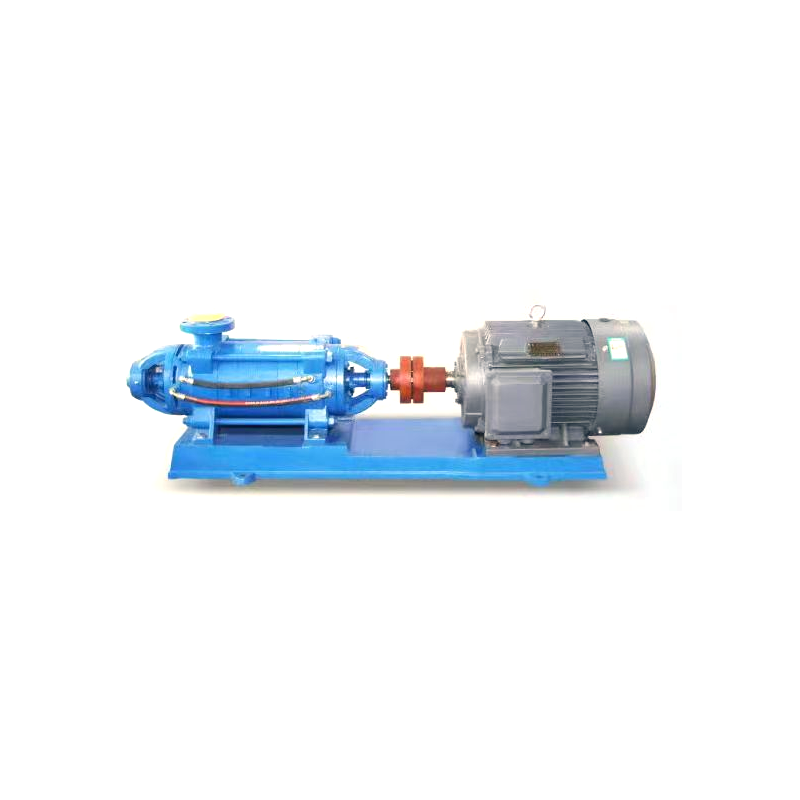
Convenient installation and maintenance Horizontal installation: The D-type multistage pump is generally installed horizontally, with the suction port horizontal and the discharge port vertically upward. This installation method is convenient for the connection and layout of the pipeline, and is also conducive to the inspection and maintenance of the pump, reducing the difficulty of installation and maintenance. Simple structure: The structure of the pump is relatively simple, mainly composed of pump body, impeller, shaft, guide vane, guide vane sleeve and balance plate. The disassembly and installation of each component are relatively convenient, which is convenient for maintenance personnel to carry out daily inspection, maintenance and replacement of wearing parts.
High strength and high quality Excellent material: The D-type multistage pump is made of high-strength and high-quality materials, such as high-quality cast iron and cast steel, which improves the strength and durability of the pump and can adapt to different working environments and medium requirements. Precision manufacturing: The parts are manufactured with high precision. For example, the impeller and guide vane are made of precision casting technology, with smooth surface and precise flow channel size, which ensures the performance and efficiency of the pump and enables it to operate efficiently and stably.
Technical Parameters
| Pump Type | D type horizontal multistage pump |
| Material | cast iron |
| Drive type | electric |
| Maximum flow | 162 cubic meters |
| Maximum lift | 300 |
| Installation Type | Horizontal |
| Maximum caliber | DN150 |
| Maximum Power | 160KW |
| Protection level | IP54 |
| Insulation class | F |
| Standard voltage | 380V 50Hz |
Product Usage
1. Mine drainage in the mining industry: During the mining process, groundwater will continue to seep out. The D-type multistage pump can effectively drain the accumulated water at the bottom of the mine to the ground. Due to the deep depth of the mine, a higher head is required to overcome the water level difference. The high head characteristics of the D-type multistage pump (the head range is generally 13-900m) can meet this demand well. For example, in some coal mines hundreds of meters deep, the D-type multistage pump can continuously and stably discharge water to ensure the safety of the underground working environment. Slurry transportation (after appropriate modification): For some slurries containing ore particles, the D-type multistage pump can also be used for slurry transportation by replacing the flow parts of the D-type multistage pump with wear-resistant materials and adjusting the sealing method. It can transport slurry from the underground mining area to the ground beneficiation plant and other processing places to achieve effective transportation of ore resources.
2. Water supply boosting in urban water supply and drainage systems: In the water supply system of urban high-rise buildings, since water needs to be transported to higher floors, a certain pressure is required to ensure that the water can reach the user's home smoothly. D-type multistage pumps can be used as booster pumps to pressurize water from the city's water supply mains and transport it to the rooftop water tanks of high-rise buildings or directly supply it to high-rise users. Its flow range (generally 6.3 - 850m³/h) can meet the water needs of buildings of different sizes. Drainage treatment: In the city's drainage system, D-type multistage pumps are used to lift sewage from low-lying areas (such as underground sewage pipes, sump pits in sewage treatment plants, etc.) to high-altitude sewage treatment facilities or drainage pipes to ensure that urban sewage can be discharged smoothly and prevent waterlogging.
3. Transportation of chemical raw materials in the industrial field: In the chemical production process, various liquid chemical raw materials need to be transported. If the physical and chemical properties of the chemical raw materials are similar to those of clear water (no solid particles, not corrosive, etc.), D-type multistage pumps can be used to transport these raw materials from the raw material storage tank to the reactor or other production equipment. For example, when transporting some organic solvents, diluted acid or alkali, etc., its stable flow and pressure output can ensure the precise control of the chemical production process. Industrial cooling circulation system: Many industrial equipment (such as generator sets, large compressors, cooling jackets of chemical reactors, etc.) require cooling circulating water to remove heat and prevent equipment from overheating. The D-type multistage pump can transport cooling water from the pool of the cooling tower to the cooling system of the equipment, and then send the hot water back to the cooling tower for cooling after heat exchange. Its efficient hydraulic performance can ensure the continuous and stable supply of cooling circulating water and improve the operating efficiency and service life of industrial equipment.
4. Agricultural irrigation Farmland irrigation: In agricultural irrigation, when water needs to be transported from water sources (such as rivers, lakes, deep wells, etc.) to farmlands that are far away or have higher terrain, the D-type multistage pump can play a role. According to the area of the farmland and the needs of irrigation, a D-type multistage pump with appropriate flow and head can be selected. For example, in terrace irrigation in some mountainous areas, it can lift water to a higher terrace position, and through reasonable pipeline layout, large-scale irrigation can be achieved, thereby improving agricultural production efficiency. Agricultural farm water supply: In farms, clean drinking water is needed for livestock. The D-type multistage pump can transport water from the water source to various drinking water points in the farm to ensure that livestock can get enough drinking water at any time. At the same time, in some aquaculture farms, it can also be used for water circulation and water exchange operations.
Product Operation Guide
Preparation before starting Check installation: Make sure the pump and motor are firmly installed, the coupling is well connected, and there is no jamming when rotating the coupling. Lubrication system: Check the oil level and quality of the lubricating oil (grease). Cooling system (if any): Check the cooling water pipeline, pressure and flow. Electrical system: Check the motor wiring, insulation and power supply voltage. Inlet and outlet pipelines: Make sure the inlet pipeline is unobstructed, the filter is clean, and close the outlet valve. Start operation Fill the pump (centrifugal pump): Fill the pump cavity with liquid. Start the motor: Pay attention to the starting current and rotation direction. Slowly open the outlet valve: Adjust the flow. Check the pressure and flow during operation: Observe whether it is stable and meets the requirements. Vibration and noise: Check whether the vibration and sound are normal. Temperature: Check the bearing and cooling water temperature. Seal: Check the leakage of mechanical seals or packing seals. Shutdown operation Close the outlet valve. Stop the motor. Close the inlet valve (long-term shutdown) and cooling water valve, drain the accumulated water (cold environment), and record relevant information.
Frequently asked questions
1. Reasons for insufficient flow: inlet blockage, impeller problem, insufficient speed, outlet leakage. Solution: clean the inlet, replace the impeller, check the motor and transmission device, and repair the outlet pipe.
2. Reasons for abnormal pressure: pressure gauge failure, cavitation, impeller damage or blockage, outlet blockage. Solution: replace the pressure gauge, avoid cavitation, clean or replace the impeller, and clean the outlet pipe.
3. Reasons for excessive vibration of the pump body: coupling misalignment, impeller imbalance, bearing damage, loose pump foundation. Solution: re-center, balance the impeller, replace the bearing, and tighten the foundation.
4. Reasons for bearing overheating: poor lubrication, improper assembly, bearing damage, and excessive axial force. Solution: improve lubrication, correct assembly, replace bearings, and balance axial force.
5. Reasons for seal leakage: mechanical seal wear, packing seal aging, flushing system failure. Solution: replace the mechanical seal, replace the packing, and check the flushing system.