close
Choose Your Site
Global
Social Media


 |


| Quantity: | |
|---|---|

Introduce the basic functions of the product
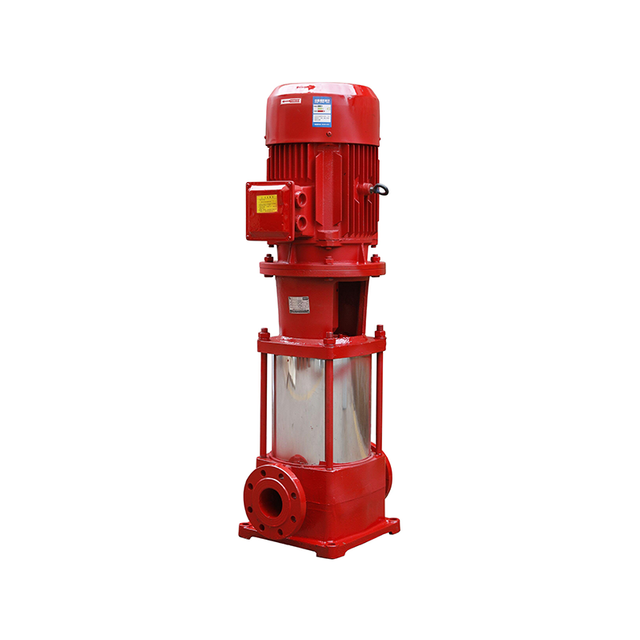
1. Efficient Firefighting Water Supply: As a core function, the system utilizes an end-suction pump structure (liquid is drawn in at one end and discharged at the other) to rapidly pressurize water from firefighting tanks/sources, delivering a flow rate (e.g., meeting firefighting water requirements in different locations) and pressure (ensuring water flow can reach high-rise buildings, remote fire sites, or firefighting equipment) that complies with firefighting regulations. This provides a continuous water supply for firefighting terminals such as fire hydrants and automatic sprinkler systems.
2. Emergency Startup and Operation: The system supports both manual and automatic startup modes. In automatic mode, it can be linked to the fire control center, rapidly starting upon receiving a fire signal (typically within the required startup time for firefighting emergency response). The system exhibits stable anti-interference capabilities during operation, ensuring continuous operation during firefighting operations, preventing pressure fluctuations and sudden changes in flow from impacting firefighting effectiveness.
3. Safety protection and adaptability: It has built-in basic protection functions such as overload, overpressure, phase loss, and mechanical seal leakage to prevent the pump unit from being damaged due to faults and ensure reliable operation in emergencies. It can also be adapted to different fire protection systems (such as fire hydrant systems and sprinkler systems), and some models can be used in conjunction with pressure-stabilizing pumps, control cabinets, etc. to form a complete fire water supply unit, which is suitable for the fire protection needs of various buildings (such as factories, office buildings, and residential communities).
Usage Environment
1. Space and Installation Environment: The pump must be installed in a well-ventilated, dust-free, or corrosive-free fire pump room. Avoid moisture and water accumulation (relative humidity is typically ≤85%, non-condensing), and allow for maintenance and inspection (to accommodate pump assembly, disassembly, and maintenance).
2. Temperature: The ambient temperature must be controlled between 5°C and 40°C (some low-temperature compatible models can be extended to -10°C) to prevent freezing and cracking of the pump body or high temperatures affecting the motor insulation.
3. Water Source Compatibility: The pumped water source must be clean and free of solid impurities (particle size ≤0.1mm) to prevent clogging of the pump body by silt, fiber, and other debris. The water source temperature is typically ≤60°C. Special models can be adapted for high-temperature firefighting scenarios (this requires prior confirmation).
4. Electrical Environment: The electrical facilities in the pump room must comply with fire protection and explosion-proof/electric shock protection standards (if not in an explosion-proof environment, keep them away from flammable and explosive materials). The power supply voltage must be stable (rated 380V with a fluctuation range of ≤±10%) to prevent phase loss and voltage fluctuations that may affect pump startup and operation.
Product Advantages
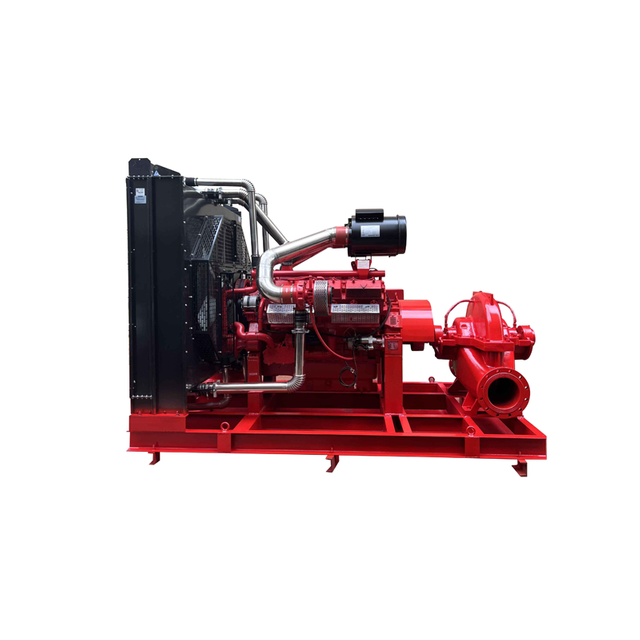
More reliable water supply: Supports electric + diesel engine dual power, or "one in use and one backup" design, which can continue to supply water in the event of power failure or single pump failure to avoid power outage;
Fast startup response: It can complete startup and reach full load within 15 seconds, quickly connect to firefighting needs, and seize the golden time for firefighting;
Automation and worry-free: It can automatically start and stop, failover, and can be remotely monitored and controlled without excessive manual intervention;
Strong environmental tolerance: The motor has a high protection level (IP55 and above), and the diesel engine model can operate in -15℃-55℃ working conditions, suitable for humid, outdoor and other complex scenarios;
Safety and security: It has multiple protections such as overspeed, low oil pressure, and high water temperature, and monitors abnormalities in real time and issues alarms.
Technical Parameters
| Pump Type | EDJ type end suction fire pump unit |
| Material | cast iron |
| Drive type | Electric diesel |
| Maximum flow | 1800L/S |
| Maximum lift | 200 meters |
| Installation Type | Vertical |
| Maximum caliber | DN500 |
| Maximum Power | 710KW |
| Protection level | IP54 |
| Insulation class | F |
| Standard voltage | Single-phase voltage IX220-230/1240V Three-phase voltage 3X200-220/1346-380V 3X220-240/1380-415V 3X220-255/380-440V |
Product Usage
Civil buildings: residential areas, high-rise residential buildings, villas, shopping malls, hotels, etc., to meet the emergency water supply needs of fire hydrants and sprinkler systems to deal with daily and sudden fires;
Industrial buildings: factory workshops, warehouses (especially flammable warehouses), industrial parks, etc., adapt to the high fire protection level requirements of industrial sites and ensure fire safety in production areas;
Special risk sites: oil depots, oil loading and unloading terminals, chemical parks and other flammable and explosive scenes, the dual-power design can avoid water supply interruptions caused by power failures and reduce the risk of fire spread;
Public facilities: hospitals, schools, stadiums, transportation hubs (airports, train stations) and other crowded places, the fast start feature can seize the golden time for firefighting, reducing casualties and property losses.
Product Operation Guide
I. Pre-Startup Inspection (Required)
1.Appearance: Verify that the pump unit is free of damage, connections are tight, and there is no excessive leakage from the shaft seal.
2.Power: For electric pumps, check that the power supply is stable and the cable is secure. For diesel pumps, check that the oil level, water level, and battery are charged.
3.Valves: Open the inlet valve to allow water to flow, and close the outlet valve (to prevent overpressure during startup).
4.Turning the pump shaft: Manually turn the pump shaft 2-3 turns to ensure there is no sticking or noise.
II. Pump Starting Operation
1.Electric Pump: Press the start button. Once operation stabilizes, slowly open the outlet valve and observe the pressure gauge until the rated pressure is reached.
2.Diesel Pump: Start according to the diesel engine starting procedure. Once operation is normal, slowly open the outlet valve and adjust to the rated pressure.
III. Operation Monitoring (Critical)
1.Check the pressure: Ensure the pressure gauge reading is stable within the rated range. Adjust the outlet valve immediately if it exceeds the range.
2.Check the temperature: Ensure the bearing temperature is ≤75°C and the motor/diesel engine is not overheating.
3. Listen for abnormal noise or vibration. Stop the pump immediately if any problems occur.
IV. Pump Stop Operation
1.Slowly close the outlet valve first;
2.Press the stop button for the electric pump and the diesel pump according to the shutdown procedures;
3. Finally, close the inlet valve and record the pump stop time and status
Frequently asked questions
Startup failure
Motor does not respond;
Motor hums but does not rotate;
Overload shutdown after startup
Abnormal performance
Pressure/flow is lower than the rated value;
Pressure/flow fluctuation
Seal leakage
Water dripping from the shaft seal exceeds the standard;
Flange joint leakage
Abnormal vibration noise
Pump body vibrates violently;
Abnormal noise from bearings/pump chamber
Motor failure
Motor overheating;
Motor tripping